

Men’s Style and Identity in New York City

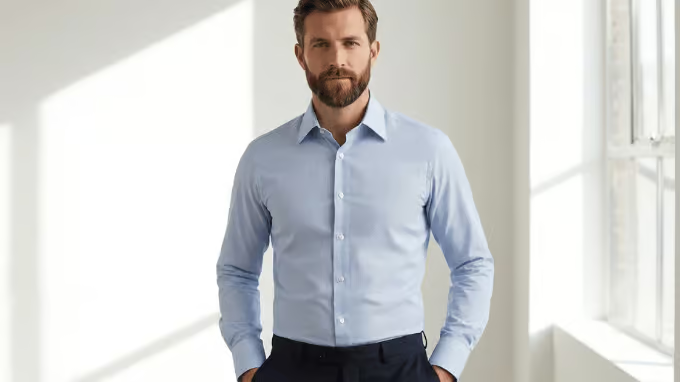
What does it mean to dress well. For the professional man navigating boardrooms, social engagements, and the quiet rituals of daily life, this question carries real weight Learn more about [a light blue royal oxford shirt with timeless fabric character](https://blacklapel.com/products/light-blue-royal-oxford-dress-shirt). Men’s style is not merely a matter of vanity or trend-chasing. It is a discipline rooted in history, psychology, craftsmanship, and self-knowledge. The man who understands why he dresses the way he does — not just how — possesses a rare and powerful advantage.
This guide synthesizes the core lessons of four foundational books on men’s fashion and classic menswear:
- True Style: The History and Principles of Classic Menswear by G. Bruce Boyer (2015)
- The Meanings of Dress by Mary Lynn Damhorst, Kimberly A. Miller-Spillman, and Susan O. Michelman (2005)
- Dressing the Man: Mastering the Art of Permanent Fashion by Alan Flusser (2002)
- Uniforms and Nonuniforms: Communication Through Clothing by Nathan Joseph (1986)
Together, these works form a comprehensive intellectual framework for any man who wants to dress with intention, authority, and lasting elegance. Whether you are building a wardrobe from scratch, refining an existing one, or simply trying to understand why clothing matters as much as it does, the principles gathered here will serve you for a lifetime.

The History of Classic Menswear: Why the Past Still Matters
From Court Dress to the Modern Suit
To understand men’s style today, you must understand where it came from. Boyer (2015) traces the evolution of classic menswear from the elaborate court dress of seventeenth-century Europe through the revolutionary simplicity of the English country gentleman, arriving finally at the modern suit — arguably the most enduring garment in the history of Western dress. This arc is not merely decorative history. It reveals a consistent tension between display and restraint, between the desire to signal status and the equally powerful desire to project competence and seriousness.
The English tailoring tradition, which Boyer (2015) identifies as the bedrock of classic menswear, emerged from a cultural shift in the eighteenth century. As the landed gentry began to value practicality alongside elegance, the fussy ornamentation of Continental fashion gave way to cleaner lines, superior cloth, and meticulous construction. Savile Row became the global standard not because it was the most fashionable address in the world, but because it was the most technically rigorous. The bespoke suit that emerged from this tradition was designed to fit one body and one body only — a philosophy that remains the gold standard of men’s dress to this day.
Flusser (2002) extends this historical perspective by arguing that the principles governing great menswear have remained essentially unchanged for over a century. The proportions of a well-cut jacket, the relationship between collar and tie, the way a trouser should break over the shoe — these are not arbitrary conventions. They are the accumulated wisdom of generations of craftsmen and well-dressed men who understood that clothing must work in harmony with the human body. Fashion changes. Style, properly understood, does not.
The Democratization of Dress
Joseph (1986) offers a sociological lens through which to view this history. His analysis of uniforms and nonuniforms reveals that clothing has always functioned as a system of communication, encoding information about rank, affiliation, and social role. The gradual democratization of dress in the twentieth century — the loosening of rigid dress codes, the rise of ready-to-wear, the casualization of the workplace — did not eliminate these communicative functions. It complicated them.
When everyone can wear a suit, the suit itself becomes a more nuanced signal. The quality of the cloth, the precision of the cut, the choice of accessories — these details carry the weight that explicit sumptuary laws once carried in earlier centuries. The man who understands this history is better equipped to navigate the subtleties of contemporary dress (Joseph, 1986).
The Psychology of Clothing: What You Wear Communicates Who You Are
Dress as Social Language
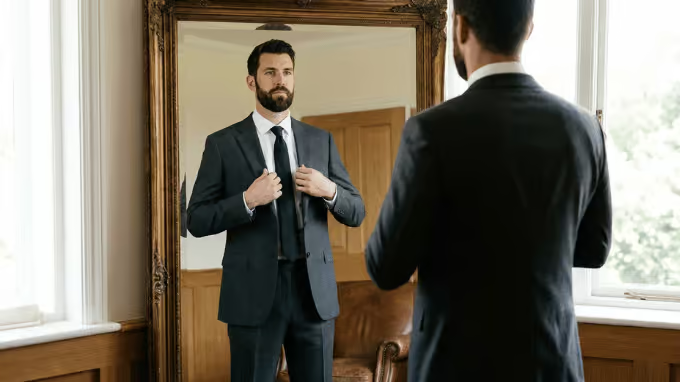
Damhorst et al. (2005) provide the most rigorous academic treatment of clothing’s communicative power. Drawing on sociology, psychology, and cultural studies, they argue that dress functions as a complex social language — one that operates simultaneously on multiple levels. At the most basic level, clothing communicates demographic information: age, gender, socioeconomic status, and professional role. At a deeper level, it communicates values, personality, and group membership.
This is not a trivial observation. Research cited by Damhorst et al. (2005) consistently demonstrates that observers form rapid and surprisingly accurate judgments about individuals based on their clothing. These judgments influence hiring decisions, social interactions, and even legal outcomes. The professional man who dismisses the importance of dress as superficial is, in effect, choosing to communicate carelessly — to leave a powerful channel of self-expression unmanaged.
Identity, Conformity, and Individuality
One of the most intellectually rich tensions in the literature on men’s style is the relationship between conformity and individuality. Joseph (1986) argues that uniforms — whether literal military uniforms or the figurative uniform of the business suit — serve a dual function. They signal membership in a group and submission to its norms, while simultaneously conferring the authority and credibility associated with that group. The man in a well-tailored suit is, in a sense, wearing a uniform. But the quality of his cloth, the fit of his jacket, and the precision of his accessories mark him as an individual within that uniform.
Boyer (2015) frames this tension in terms of personal style versus fashion. Fashion is external, cyclical, and driven by commercial interests. Personal style is internal, consistent, and driven by self-knowledge. The truly well-dressed man is not the one who wears the most fashionable clothes, but the one who has developed a coherent visual identity that reflects his values, his body, and his life. This is a distinction that takes years to develop — and it is precisely what separates the man with genuine style from the man who merely follows trends.
Damhorst et al. (2005) add an important nuance here: clothing choices are never made in a social vacuum. Every garment is chosen in relation to a specific context, audience, and set of expectations. The man who wears a beautifully tailored suit to a casual weekend gathering may be communicating something very different from what he intends. Dressing well requires not just knowledge of clothing, but social intelligence — an understanding of context and audience that allows you to calibrate your dress appropriately.
The Confidence Effect
There is a well-documented psychological dimension to dressing well that goes beyond social perception. Damhorst et al. (2005) review research suggesting that clothing affects not only how others perceive us, but how we perceive ourselves. When a man wears clothing that fits well, is made from quality materials, and reflects his personal values, he tends to carry himself differently. His posture improves. His confidence increases. His performance in professional and social settings is measurably enhanced.
This is not mere vanity. It is a recognition that the body and the mind are not separate systems. What we put on our bodies affects how we inhabit them — and how we inhabit our bodies affects how we engage with the world. The investment in quality menswear is, in this sense, an investment in personal effectiveness.

Practical Wardrobe Building: The Principles of Timeless Style
Start With the Body, Not the Clothes
Flusser (2002) opens his masterwork with a principle that is both simple and radical: the starting point for any well-dressed man is not the clothes, but the body. Specifically, it is the relationship between the man’s coloring — his skin tone, hair color, and eye color — and the colors and patterns of his clothing. Flusser argues that the most important factor in determining whether a garment looks good on a man is not its brand, its price, or its fashionability, but whether its colors and patterns harmonize with his natural coloring.
This principle has profound practical implications. It means that the same suit that looks magnificent on one man may look mediocre on another — not because of fit or quality, but because of color. It means that the first step in building a wardrobe is not visiting a tailor or a shop, but developing an honest understanding of your own coloring and the palette that works best with it. Flusser (2002) provides detailed guidance on this process, identifying four broad coloring types and the color families that complement each.
The Foundation Garments of Classic Menswear
Boyer (2015) and Flusser (2002) converge on a core set of foundation garments that every well-dressed man should own. These are not trendy pieces or statement items. They are the workhorses of a classic wardrobe — versatile, enduring, and capable of being dressed up or down depending on context.
- A well-fitted navy suit — The single most versatile garment in a man’s wardrobe. Navy works with virtually every shirt and tie combination, reads as authoritative without being aggressive, and transitions seamlessly from business to social occasions (Flusser, 2002).
- A grey flannel suit — The ideal complement to the navy suit. Grey flannel has a softness and depth that navy lacks, and it pairs beautifully with both white and blue shirts (Boyer, 2015).
- A navy blazer — The cornerstone of smart-casual dressing. Paired with grey flannel trousers, it approximates the formality of a suit. Paired with chinos or dark denim, it anchors a relaxed but polished look (Flusser, 2002).
- White and blue dress shirts — The foundation of any shirt wardrobe. White is the most formal and versatile; blue adds warmth and personality without sacrificing professionalism (Boyer, 2015).
- A trench coat or overcoat in camel or charcoal — Outerwear is the first thing people see and the last thing they remember. A quality overcoat elevates any outfit beneath it (Flusser, 2002).
- Quality leather shoes in black and brown — Shoes are the most reliable indicator of a man’s attention to detail. A well-maintained pair of Oxford or Derby shoes in black and a brogue or loafer in brown covers the vast majority of occasions (Boyer, 2015).
- A selection of ties in silk — Ties remain the primary vehicle for color and pattern in formal menswear. A small collection of quality silk ties in solid colors, regimental stripes, and small patterns provides enormous versatility (Flusser, 2002).
Fit: The Non-Negotiable Foundation
Every authority on men’s style agrees on one point above all others: fit is paramount. A moderately priced suit that fits perfectly will always look better than an expensive suit that does not. Flusser (2002) is characteristically precise on this point, providing detailed guidance on how a jacket should sit on the shoulders, how much shirt cuff should show, how a trouser should drape from the hip to the shoe.
- Shoulder seam should sit exactly at the edge of the shoulder, with no overhang or pulling
- Chest should button without strain, with enough room to slip a hand inside comfortably
- Waist suppression should follow the natural contour of the body without pinching
- Jacket length should cover the seat and allow the fingers to curl under the hem when arms hang naturally
- Sleeve length should allow approximately half an inch of shirt cuff to show
These are not arbitrary rules. They are the product of centuries of tailoring experience, refined to ensure that the jacket works with the body rather than against it (Flusser, 2002).
Quality Over Quantity: The Investment Mindset
Boyer (2015) makes a compelling case for what he calls the investment mindset in wardrobe building. Rather than buying many inexpensive garments that wear out quickly and look mediocre from the start, the well-dressed man buys fewer, better things — garments made from quality materials by skilled craftsmen, designed to last for decades rather than seasons.
This approach is not merely aesthetic. It is economic. A well-made suit from a quality manufacturer, properly cared for, will outlast five or six cheaper suits. The cost per wearing, calculated over a decade, is often lower for the expensive garment than for the cheap one. More importantly, the quality garment improves with age in a way that cheap clothing never does. A well-worn pair of quality leather shoes, a broken-in tweed jacket, a silk tie that has developed a subtle patina — these are the marks of a man who understands that true style is built over time, not purchased in a single shopping trip (Boyer, 2015).

How Clothing Communicates Identity and Status
The Semiotics of Dress
Joseph (1986) provides the most systematic analysis of how clothing communicates identity and status. Drawing on semiotic theory, he argues that garments function as signs — objects that carry meaning beyond their physical properties. The meaning of any garment is not fixed or inherent. It is produced through a complex interaction between the garment itself, the person wearing it, the context in which it is worn, and the cultural codes shared by the wearer and the observer.
This semiotic perspective has important practical implications for the man who wants to dress well. It means that there is no universal formula for dressing appropriately or impressively. The same garment can communicate authority in one context and arrogance in another, elegance in one culture and eccentricity in another. The well-dressed man must be a skilled reader of social codes — someone who understands not just the grammar of dress, but its pragmatics (Joseph, 1986).
Dress and Professional Authority
Damhorst et al. (2005) review an extensive body of research on the relationship between dress and professional authority. The findings are consistent and striking. Men who dress in ways that signal competence, status, and attention to detail are perceived as more authoritative, more trustworthy, and more capable than men who dress carelessly or inappropriately. These perceptions influence hiring decisions, promotion outcomes, client relationships, and negotiating dynamics.
Importantly, this effect is not simply a matter of wearing expensive clothes. It is a matter of wearing appropriate clothes well. A man in a perfectly fitted, moderately priced suit will often make a stronger impression than a man in an expensive suit that fits poorly or is worn carelessly. The signal being read is not the price tag, but the care and intentionality behind the choices (Damhorst et al., 2005).
Dress as Self-Expression and Personal Narrative
Boyer (2015) argues that the highest form of men’s style is not the mastery of rules, but the development of a personal narrative through dress. The truly well-dressed man uses clothing to tell a coherent story about who he is, what he values, and how he engages with the world. This narrative is built over years, through the accumulation of garments that have personal meaning — a tweed jacket bought on a trip to Scotland, a watch inherited from a grandfather, a pair of shoes resoled three times because they are too good to replace.
This is the dimension of men’s style that no guide can fully teach, because it is irreducibly personal. But it is also the dimension that separates the man with genuine style from the man who merely dresses correctly. The former uses clothing as a form of self-expression. The latter uses it as a form of compliance. Both may be well-dressed by conventional standards, but only the former is truly stylish (Boyer, 2015).

Developing Your Personal Style: A Practical Framework
Step One: Know Your Body and Coloring
Following Flusser’s (2002) foundational principle, the first step in developing personal style is an honest assessment of your body and coloring. This means understanding your proportions — the relationship between your shoulders, chest, waist, and hips — and identifying the color palette that harmonizes with your skin tone, hair, and eyes. This self-knowledge is the foundation on which all subsequent choices rest.
Step Two: Build the Foundation Before the Details
Boyer (2015) advises building the foundation of your wardrobe before investing in statement pieces or accessories. The foundation — the suits, shirts, shoes, and outerwear described above — should be in place and working well before you begin adding personality through ties, pocket squares, watches, and other details. A man with a strong foundation and minimal accessories will always look better than a man with a weak foundation and elaborate accessories.
Step Three: Invest in Fit and Quality
Flusser (2002) and Boyer (2015) are united on this point: the two most important investments a man can make in his wardrobe are fit and quality. If you can afford only one bespoke or made-to-measure garment, make it your primary suit. If you can afford only one pair of quality shoes, make them black Oxfords. Build from the most important items outward, always prioritizing fit and quality over quantity and variety.
Step Four: Develop Context Awareness
Drawing on Damhorst et al. (2005) and Joseph (1986), the fourth step is developing a sophisticated awareness of context. This means understanding the dress codes — explicit and implicit — of the environments you inhabit, and calibrating your choices accordingly. It means knowing when to dress up and when to dress down, when to conform and when to distinguish yourself, when to signal authority and when to signal approachability.
Step Five: Build a Personal Narrative Over Time
Finally, following Boyer’s (2015) vision of style as personal narrative, the fifth step is the most open-ended: build your wardrobe over time, with intention and patience. Buy things that have meaning to you. Invest in quality that will last. Develop relationships with craftsmen — tailors, shoemakers, shirt makers — who understand your body and your taste. Allow your style to evolve as you evolve, while maintaining the coherent visual identity that makes you recognizable and memorable.

The Enduring Principles of Men's Style
What emerges from a careful reading of these four foundational texts is a set of enduring principles that transcend any particular trend or era. These principles are worth stating plainly, because they are the distillation of centuries of accumulated wisdom about how men dress and why it matters.
The core principles of timeless men’s style are:
- Fit is the foundation of everything. No amount of quality, expense, or fashionability can compensate for poor fit. Every garment must work with your body.
- Color harmony is the second most important factor. Your clothing must harmonize with your natural coloring. This is not a matter of taste but of visual logic (Flusser, 2002).
- Quality outlasts fashion. Invest in well-made garments from quality materials. They will serve you better and longer than cheap alternatives (Boyer, 2015).
- Dress communicates. Every choice you make about clothing sends a signal. Manage that signal with intention (Damhorst et al., 2005).
- Context is everything. The same garment can be appropriate or inappropriate, impressive or ridiculous, depending on context. Develop the social intelligence to read context accurately (Joseph, 1986).
- Style is personal. The goal is not to dress like someone else, but to develop a coherent visual identity that reflects who you are and what you value (Boyer, 2015).
- Patience is a virtue. Great style is built over years, not purchased in an afternoon. The investment mindset — buying fewer, better things and caring for them well — is the foundation of a truly distinguished wardrobe.
FAQs
Q: What is the single most important principle of men's style?
A: According to Flusser (2002), fit is the single most important principle of men’s style. A garment that fits perfectly will always look better than an expensive garment that does not fit well. Before investing in quality or variety, every man should ensure that his existing wardrobe fits correctly — and be willing to invest in alterations or bespoke tailoring to achieve that fit.
Q: How many suits does a professional man actually need?
A: Boyer (2015) suggests that two well-chosen suits — a navy and a grey — form a sufficient foundation for most professional wardrobes. These two suits, combined with a navy blazer and a selection of quality trousers, can cover the vast majority of professional and social occasions. The emphasis should always be on quality and fit rather than quantity.
Q: How does clothing affect professional success?
A: Research reviewed by Damhorst et al. (2005) consistently demonstrates that clothing significantly affects professional outcomes. Men who dress in ways that signal competence, status, and attention to detail are perceived as more authoritative and capable, which influences hiring decisions, promotions, and client relationships. Dressing well is not vanity — it is a professional investment.
Q: What is the difference between fashion and style?
A: Boyer (2015) draws a clear distinction between fashion and style. Fashion is external, cyclical, and commercially driven — it changes with the seasons and is designed to create desire for new things. Style is internal, consistent, and driven by self-knowledge — it reflects who you are and what you value, and it endures across trends. The goal of a well-dressed man is to develop personal style, not to follow fashion.
Q: How does clothing communicate identity and status?
A: Joseph (1986) explains that clothing functions as a semiotic system — a set of signs that communicate meaning beyond the physical properties of the garments themselves. The meaning of any garment is produced through the interaction between the garment, the wearer, the context, and the cultural codes shared by wearer and observer. Clothing communicates demographic information, professional role, group membership, values, and personality — often more powerfully and rapidly than words.
Q: What is the best way to start building a classic men's wardrobe?
A: Flusser (2002) recommends starting with an honest assessment of your body and coloring, then building the foundation of your wardrobe — a navy suit, a grey suit, a navy blazer, quality shirts, leather shoes, and a good overcoat — before investing in accessories or statement pieces. Boyer (2015) adds that the investment mindset — buying fewer, better things and caring for them well — is the most effective long-term strategy for building a distinguished wardrobe.
Q: Why do classic menswear principles remain relevant in an era of casual dress?
A: Boyer (2015) argues that the principles of classic menswear remain relevant precisely because they are not tied to any particular trend or era. They are based on enduring truths about the human body, color harmony, and the communicative function of dress. As Joseph (1986) and Damhorst et al. (2005) demonstrate, clothing continues to communicate identity and status even in casual contexts — the signals have simply become more subtle and more dependent on quality and fit than on explicit dress codes.
Conclusion
The man who dresses well is not the man who spends the most money or follows the latest trends. He is the man who has taken the time to understand himself — his body, his coloring, his values, and his context — and who uses that self-knowledge to make intentional, coherent choices about how he presents himself to the world.
The four books examined in this guide offer complementary perspectives on this project. Boyer (2015) provides the historical and philosophical foundation, tracing the evolution of classic menswear and arguing for the enduring value of personal style over fashion. Flusser (2002) provides the practical technical framework, offering precise guidance on fit, color, and the construction of a classic wardrobe. Damhorst et al. (2005) provide the psychological and sociological context, demonstrating the profound ways in which clothing shapes perception, identity, and professional outcomes. And Joseph (1986) provides the semiotic framework, revealing the complex communicative functions that clothing serves in social life.
Together, these perspectives form a comprehensive guide to men’s style that is both intellectually rigorous and practically useful. The man who internalizes these lessons will not merely dress better. He will understand why he dresses the way he does — and that understanding is the foundation of genuine, lasting style.
References
Boyer, G. B. (2015). [*True style: The history and principles of classic menswear*](https://www.amazon.com/True-Style-History-Principles-Menswear/dp/0465038417). Basic Books.
Damhorst, M. L., Miller-Spillman, K. A., & Michelman, S. O. (Eds.). (2005). [*The meanings of dress*](https://www.amazon.com/Meanings-Dress-Mary-Lynn-Damhorst/dp/1563672774) (2nd ed.). Fairchild Publications.
Flusser, A. (2002). [*Dressing the man: Mastering the art of permanent fashion*](https://www.amazon.com/Dressing-Man-Mastering-Permanent-Fashion/dp/0060191449). HarperCollins.
Joseph, N. (1986). [*Uniforms and nonuniforms: Communication through clothing*](https://www.amazon.com/Uniforms-Nonuniforms-Communication-Through-Contributions/dp/0313238480). Greenwood Press.