

Discover what makes a suit truly bespoke — from full canvas construction to hand stitching, pricing, and how to find the right tailor. A complete expert guide.
What Is a Bespoke Suit? The Luxury Menswear Standard
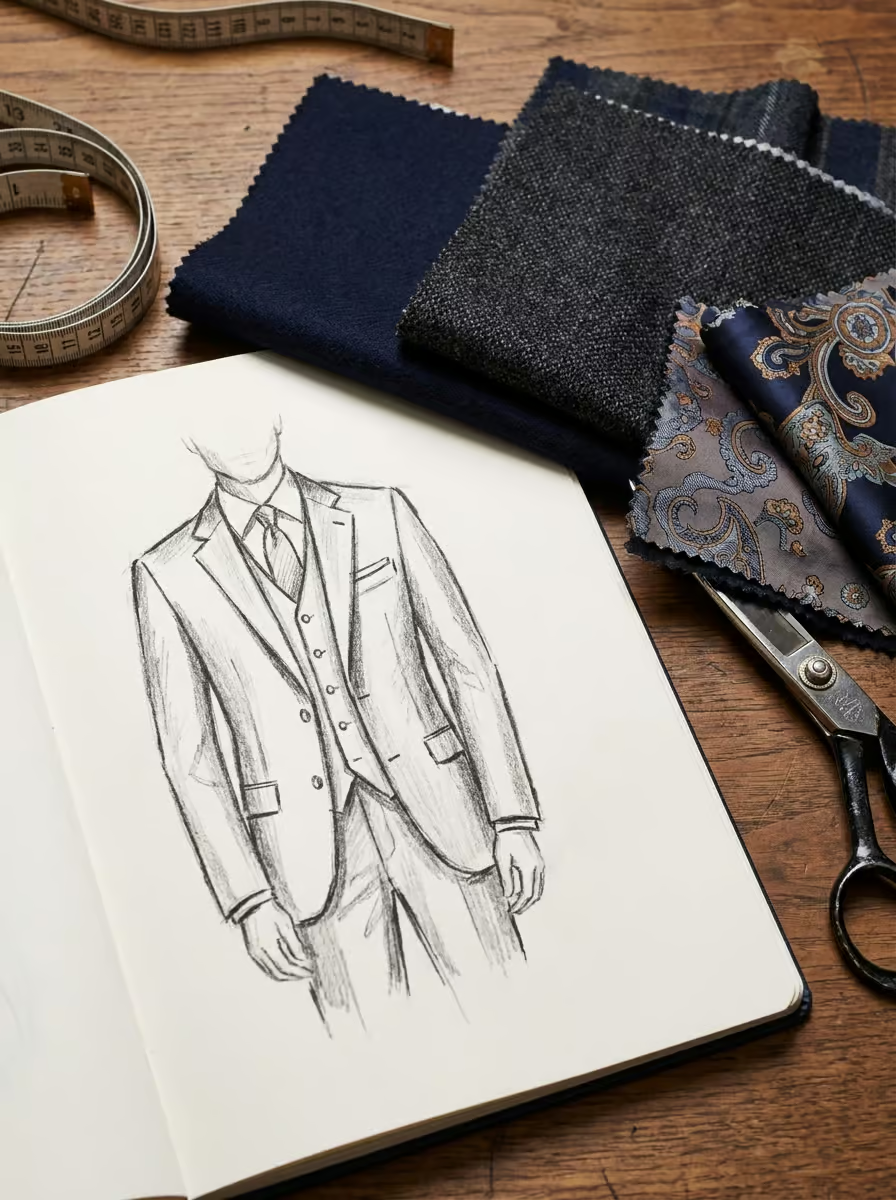
A bespoke suit is a garment constructed entirely from scratch, built around a single body, for a single person — with no pre-existing pattern, no shared block, and no compromise. The word itself derives from the past tense of "bespeak," meaning to speak for something in advance. When a man commissioned a luxury suit fabric selection from a Savile Row tailor in the 18th century, the cloth was said to have been "bespoken." That etymology still defines the standard today.
A true bespoke suit is not simply a suit with custom details. It is a suit whose entire structure begins with the wearer. The pattern, shoulder balance, chest shape, sleeve pitch, trouser rise, and finishing details are developed for one body and one purpose. That is why bespoke remains the luxury menswear standard. It is not about excess. It is about exactness.
- Bespoke vs. Made-to-Measure vs. Off-the-Rack
- The Bespoke Tailoring Process, Step by Step
- What Makes a Suit Truly Bespoke: Construction Details
- Bespoke Suit Pricing: What to Expect
- How to Care for a Bespoke Suit
- The US Bespoke Landscape: A Factual Comparison
- Frequently Asked Questions About Bespoke Suits
Bespoke suits for weddings is not a marketing term. It is a method H.M. Cole tailoring philosophy. And understanding the distinction between bespoke, made-to-measure, and off-the-rack is the first step toward making a decision that reflects who you are — not simply what fits.
The distinction matters because suits are not all built with the same logic. One suit begins with a rack size. Another begins with a base pattern. A bespoke suit begins with the person. That starting point changes everything that follows: the measurement process, the number of fittings, the construction method, the level of handwork, the final fit, and the way the garment ages over time.
Bespoke tailoring is not just customization. It is the creation of a garment from an original pattern, refined through fittings, and built to belong to one man alone.
Bespoke vs. Made-to-Measure vs. Off-the-Rack
The menswear market uses these three terms with varying degrees of precision. The differences are not cosmetic — they are structural custom suits across the Mountain West.
Off-the-Rack
Off-the-rack suits are manufactured in standardized sizes — 40R, 42L, 44S — designed to approximate the proportions of a statistical average. The pattern is fixed. The construction is machine-driven. The fit is a starting point, not a destination. For a man whose body conforms closely to those averages, a well-chosen off-the-rack suit with skilled alterations can perform adequately. For most men, it cannot.
The main limitation is that alterations can only adjust what already exists. A tailor can shorten sleeves, hem trousers, or suppress a waist to some degree, but they cannot fully rebuild the shoulder line, armhole, balance, or jacket architecture without compromising the garment. This is why many off-the-rack suits still look slightly wrong even after tailoring.
Made-to-Measure
Made-to-measure begins with a base pattern — a pre-existing block — that is adjusted according to a client's measurements. The adjustments are real and meaningful: chest width, sleeve length, trouser break. But the underlying architecture of the garment is shared. You are modifying an existing structure, not building a new one. Brands like Indochino and Suitsupply operate in this space. The result is a better-fitting suit than off-the-rack, often at an accessible price point, but it is not bespoke.
Made-to-measure can be an excellent choice for many men, especially when guided by an experienced fitter. It offers meaningful improvements in fit and style without the full time and cost of bespoke. But it still begins from a standardized foundation, which means certain posture and proportion issues may be harder to solve completely.
Bespoke
A bespoke suit begins with a blank sheet. The tailor takes between 20 and 40 individual measurements, maps the asymmetries of the body — because no body is symmetrical — and drafts a pattern that has never existed before and will never be used for anyone else. The suit is cut, basted, fitted on the body, adjusted, fitted again, and constructed by hand over multiple sessions. The process takes weeks. The result is a garment that does not merely fit — it belongs.
The difference becomes especially clear when the body is not standard. Sloped shoulders, a prominent chest, a shorter torso, longer arms, athletic thighs, posture imbalance, or asymmetry can all be addressed more precisely in bespoke because the garment is not fighting a pre-existing pattern.
| Feature | Off-the-Rack | Made-to-Measure | Bespoke |
|---|---|---|---|
| Pattern origin | Standardized block | Modified base block | Drafted from scratch |
| Measurements taken | None | 10–15 | 20–40+ |
| Fittings required | None | 1 sometimes | 2–4 minimum |
| Construction method | Machine | Machine with hand finishing | Hand-sewn throughout |
| Canvas | Fused, glued | Fused or half-canvas | Full canvas |
| Customization depth | None | Moderate | Complete |
| Price range | $300–$800 | $500–$1,500 | $1,500–$10,000+ |
The Bespoke Tailoring Process, Step by Step
Understanding the process clarifies the value. Bespoke tailoring is not a faster version of buying a suit — it is a fundamentally different relationship between a man, his body, and the garment that will represent him.
Step 1: The Consultation
The process begins with a conversation. A skilled tailor does not open with a tape measure — they open with questions. What is the occasion? What does the client do professionally? How does he move through the world? What impression does he intend to make? The answers shape every decision that follows, from silhouette to fabric weight to lapel width.
This is where guided personalization matters. A man who has never commissioned a bespoke suit does not know what he does not know. The tailor's role is not to present an overwhelming catalog of options — it is to curate a direction based on the client's life, body, and intent.
Step 2: Measurement
The tailor takes a comprehensive set of measurements — chest, waist, seat, shoulder width, sleeve length, back length, neck, wrist, thigh, knee, inseam, and more. Critically, a skilled tailor also notes posture: whether the client carries one shoulder lower, whether he has a forward head position, whether his hips tilt. These asymmetries are not corrected — they are accommodated. The suit is built around the body as it actually exists, not as it theoretically should.
Step 3: Fabric Selection
Fabric selection is not a secondary decision. It is a primary one. The weight, weave, and fiber content of the cloth determine how the suit drapes, how it breathes, how it holds its shape over years of wear, and how it communicates quality to anyone who sees or touches it.
Bespoke tailors work with fabric houses — Loro Piana, Scabal, Dormeuil, Holland & Sherry, Vitale Barberis Canonico — whose cloths are not available in retail environments. A 120s Super wool from a heritage mill behaves differently than a 100s. A fresco weave performs differently in summer than a flannel in winter. These distinctions are not trivial. They are the difference between a suit that serves one season and one that serves a decade.
Step 4: Pattern Drafting
The tailor drafts a unique pattern based on the measurements and consultation notes. This pattern is the client's alone. It accounts for every proportion, every asymmetry, every stylistic preference discussed in the consultation. It will be refined over subsequent fittings and archived for future commissions.
Step 5: Basting and First Fitting
The suit is cut in the chosen fabric and loosely assembled — basted — with temporary stitching. The client wears this rough construction in the fitting room. The tailor observes how the garment interacts with the body in motion: where it pulls, where it gaps, where the balance needs correction. Adjustments are marked directly on the cloth.
Step 6: Construction
After the first fitting adjustments, the suit enters full construction. In true bespoke tailoring, this means hand-sewn buttonholes, hand-padded lapels, hand-felled linings, and — most critically — a full floating canvas.
Step 7: Second and Third Fittings
The suit returns for additional fittings as construction progresses. Each session refines the fit further. By the final fitting, the garment should require no further adjustment — it should simply be correct.
Step 8: Delivery
The finished suit is delivered pressed and ready. The tailor reviews the final result with the client, confirms satisfaction, and archives the pattern for future reference.
The fitting process is where bespoke becomes visible. Each appointment removes guesswork until the garment feels natural on the body.
What Makes a Suit Truly Bespoke: Construction Details
Two construction elements separate genuine bespoke from everything else: full canvas and hand stitching.
Full Canvas Construction
The chest of a suit jacket requires internal structure to hold its shape and drape correctly. In fused suits — the majority of off-the-rack and many made-to-measure garments — this structure is achieved by gluing an interfacing directly to the outer fabric. The result is a chest that feels stiff, does not breathe, and eventually separates from the fabric through dry cleaning and wear.
In a full canvas suit, a layer of horsehair canvas is floating — attached only at the edges, free to move with the body. Over time, the canvas molds to the wearer's chest, creating a fit that improves with wear. This is not a minor technical distinction. It is the difference between a suit that ages poorly and one that becomes more personal with every wearing.
Hand Stitching
Hand stitching is slower, more expensive, and more precise than machine stitching. The tension of each stitch is controlled by a human hand, not a machine setting. Buttonholes cut and sewn by hand have a character that machine buttonholes cannot replicate. Pick stitching along lapels and edges is a visible signal of hand construction — subtle, deliberate, and unmistakable to anyone who knows what they are looking at.
Pattern Matching
In a bespoke suit, patterns — stripes, checks, plaids — are matched across seams. The chest pocket aligns with the jacket front. The sleeve matches the shoulder. This requires additional fabric and additional skill. It is standard in bespoke. It is rare in anything else.
Full Canvas
Allows the jacket to mold to the wearer over time and creates a more natural chest and lapel roll.
Handwork
Adds precision, control, and character to buttonholes, linings, lapels, and finishing details.
Original Pattern
Creates a garment built around one body rather than adjusted from a standard block.
Refined Fittings
Allows the tailor to correct posture, balance, sleeve pitch, trouser line, and movement.
Bespoke Suit Pricing: What to Expect
Bespoke suit pricing reflects the labor, materials, and expertise involved. A genuine bespoke suit in the United States typically starts at $1,500 and extends to $10,000 or more for commissions involving heritage mills and senior craftsmen with decades of experience.
The variables that influence price include fabric selection, the number of fittings, the complexity of the commission, and the tailor's market and reputation. Entry-level bespoke — real pattern drafting, real fittings, full canvas — begins around $1,500 to $2,500. Mid-range commissions from established tailors with premium fabric selections fall between $2,500 and $5,000. At the upper end, commissions involving the finest available cloths and the most experienced hands can exceed $8,000 to $10,000.
This is not a purchase made casually. It is an investment in a garment that, properly cared for, will serve a man for 10 to 20 years — and improve with age.
Price should also be understood through cost per wear. A suit worn for high-value professional moments, weddings, formal events, travel, and milestone occasions can justify its investment more clearly than a suit purchased only for one night. The right bespoke suit becomes part of a long-term wardrobe strategy.
How to Care for a Bespoke Suit
A bespoke suit is a long-term relationship. The care it receives determines how long it performs at the level it was built to achieve.
- Rotate regularly: Wool needs 24 to 48 hours to recover its shape between wearings. Owning two or three suits and rotating them extends the life of each significantly.
- Brush after each wearing: A natural-bristle suit brush removes surface dust and debris before it works into the fibers. This is the single most effective daily maintenance habit.
- Steam, do not press: Steaming relaxes wrinkles without flattening the texture of the cloth. Aggressive pressing with a hot iron can damage fine wool permanently.
- Dry clean sparingly: Dry cleaning is a chemical process that degrades wool fibers over time. Reserve it for genuine stains. Spot clean where possible.
- Store on a shaped hanger: A wide, contoured wooden hanger maintains the shoulder shape of the jacket. Wire hangers distort it.
- Use a garment bag for travel: A breathable garment bag protects the suit from compression and dust without trapping moisture.
- Return to your tailor: A bespoke tailor can re-press, re-line, and adjust a suit as a body changes over time. This is part of the relationship.
The US Bespoke Landscape: A Factual Comparison
The American market for bespoke and custom suits has expanded significantly over the past decade. Understanding where different brands sit in that landscape helps a man make an informed decision.
Indochino
Indochino is a made-to-measure brand with showrooms across North America. Its model is digital-first, with in-person showrooms that function as measurement and selection points. The experience is efficient and accessible, with suits starting around $400 to $600. Indochino is not bespoke — it operates from modified base patterns, uses fused construction, and is designed for volume. For a man entering the custom suit market for the first time at a modest budget, it serves a purpose. For a man seeking a garment built to last a decade, it is a different category entirely.
Suitsupply
Suitsupply offers strong ready-to-wear and a made-to-measure program at accessible price points. Its European heritage and quality control are genuine. The brand is not positioned as bespoke and does not claim to be. It occupies the upper tier of accessible menswear — a legitimate choice for a man who wants quality without the investment of true bespoke.
Alan David, New York City
Alan David is a genuine bespoke tailor operating from a single location in New York City, with commissions starting around $1,295. The heritage is real, the craft is real, and the experience reflects decades of practice. The limitation is geographic — Alan David serves New York. For a professional in Denver, Salt Lake City, or Boise, the relationship requires travel.
Enzo Custom
Enzo Custom operates across 17 locations with a luxury positioning and a strong fabric archive. It competes directly in the multi-location custom suit space and represents a serious option for men who want personalization at scale. The brand's geographic reach is a genuine differentiator in the custom suit market.
Bhambi's Custom Tailors, New York City
Bhambi's has operated on Fifth Avenue for over 57 years. The hand-sewn construction and heritage credentials are among the strongest in the American market. Like Alan David, the limitation is a single location in a single city. The craft is exceptional; the access is narrow.
H.M. Cole: Precision Tailoring Across the Mountain West and Beyond
H.M. Cole occupies a position that does not exist elsewhere in the American bespoke market: genuine precision tailoring, delivered consistently across 13 active locations — including Boise, Salt Lake City, Denver, Colorado Springs, and nine additional markets — with a philosophy that treats the body as the blueprint for everything that follows.
The distinction is not simply geographic. It is philosophical.
Most bespoke tailors are built around a single craftsman in a single city. The experience is personal but narrow. Most multi-location custom suit brands achieve scale by standardizing the process — which means the client adapts to the system rather than the system adapting to the client.
H.M. Cole resolves this tension through what might be called guided personalization: the client is led through the commission with curated direction, not left alone with an overwhelming catalog of choices. The tailor brings expertise to the conversation. The client brings intent. The result is a garment that reflects both.
The brand's material authority is expressed not through volume of options but through depth of knowledge. Fabrics are presented with context — weight, origin, behavior across seasons, how they age. A client does not need to know the difference between a 110s and a 130s Super wool before walking in. He will understand it before he walks out.
The digital experience mirrors the in-person fitting in its precision and intentionality. Technology supports decision-making without replacing human judgment. And across all 13 locations, the standard is identical — the same measurement protocol, the same fabric archive, the same guided process, the same outcome.
For the professional man in the Mountain West — or anywhere H.M. Cole operates — this means access to a level of tailoring that previously required a flight to New York or London.
The positioning is deliberate: you are not buying a suit. You are buying alignment between who you are and how you are seen. For a man standing at a professional milestone, a wedding, a career inflection point, that alignment is not a luxury. It is a necessity.
Ready to Build a Bespoke Suit Around You?
Schedule a fitting with H.M. Cole and create a custom suit shaped around your body, your context, and the moments where presentation matters.
Schedule a Fitting